CriticON
Led UX research and concept design for CriticON, a conversational tool that encourages users to verify information before sharing by turning critical thinking into quick, gamified messaging interactions.
Project details
Overview
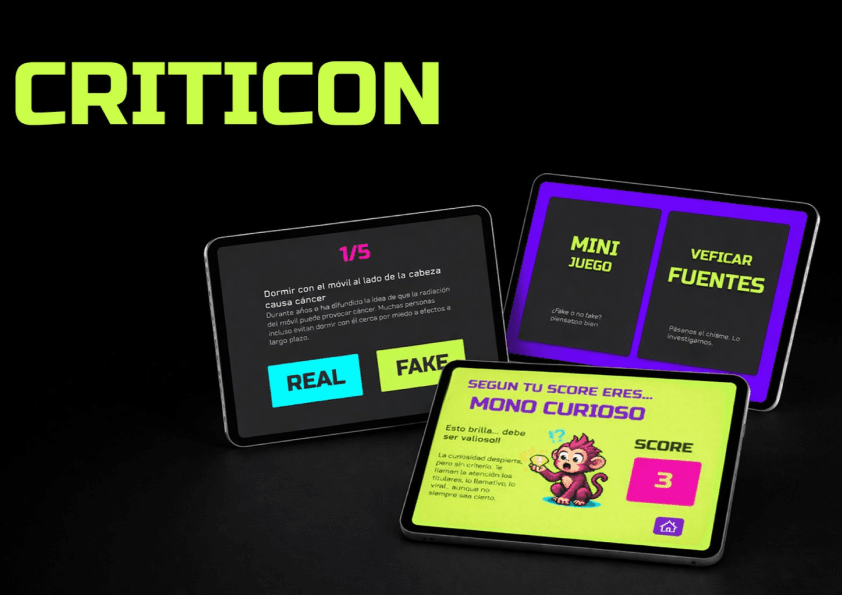
CriticON is a conversational concept designed to encourage critical thinking in digital information environments.
The solution introduces quick verification micro-interactions within messaging platforms, allowing users to send suspicious content or participate in short challenges that test their ability to detect misinformation.
Through critical streaks, mini-games, and quick verdicts, the concept aims to reinforce the habit of analyzing information before sharing it, embedding critical thinking into everyday digital behavior.
Objectives
The goal of this project was to explore how digital experiences could encourage people to develop critical thinking habits when encountering misinformation.
The research focused on understanding:
why users rarely verify the information they consume or share
what cognitive, social, and emotional barriers influence this behavior
what types of digital interactions could encourage verification without adding friction
Based on these insights, the project explores how micro-interactions, gamification, and conversational design can support everyday critical thinking practices.
The project followed a behavior-centered UX research approach to understand why users rarely verify the information they consume or share online.
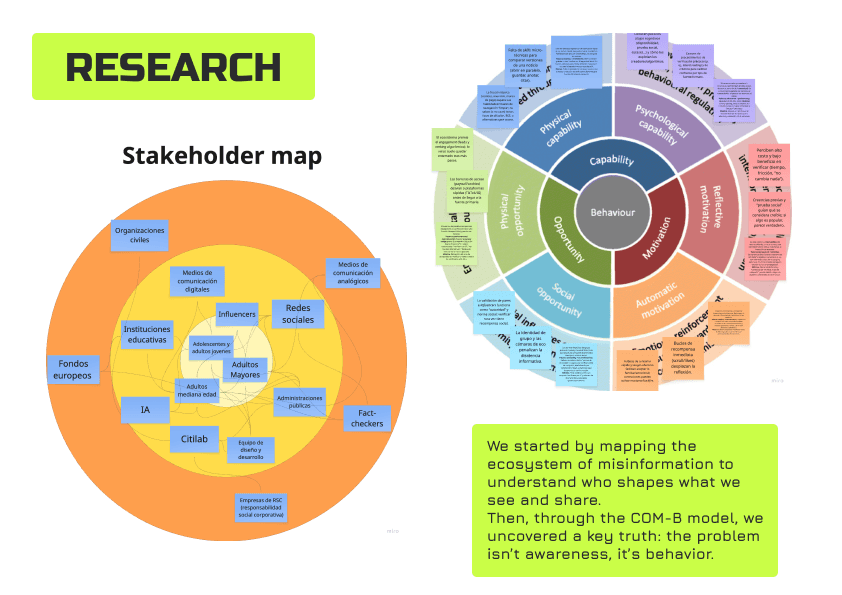
The research was structured using the COM-B framework (Capability, Opportunity, Motivation → Behaviour) to analyze the factors influencing verification behaviors. This model helped examine users’ skills to assess information credibility, the digital environments where information circulates, and the motivations that drive sharing.
To explore the problem space, several research and synthesis methods were applied, including behaviour mapping using COM-B, stakeholder mapping, root cause analysis (5 Whys), and the development of user personas representing different information consumption patterns.
These methods helped identify key barriers to verification and translate behavioral insights into design opportunities for encouraging critical thinking in digital environments.
Results
The research revealed that verification is often avoided because it requires leaving the platform, investing time, and interrupting the natural flow of content consumption. Users also rely heavily on social validation, trusting information shared by friends or familiar creators rather than evaluating credibility signals.
These insights informed the design of CriticON, a conversational concept that integrates quick verification micro-interactions directly into messaging platforms.
Instead of treating fact-checking as a separate task, the solution embeds small moments of reflection within everyday digital interactions. Through gamified elements such as critical streaks, mini-challenges, and instant feedback, the concept encourages users to pause and assess information before sharing it.
By reducing friction and aligning with existing user behaviors, CriticON explores how design interventions can support everyday critical thinking in digital environments.